
Hypervigilance or Hyperawareness – Dealing with Stress, Trauma and Overcoming PTSD and cPTSD by Jon Shore
Dealing with Stress, Trauma and Overcoming PTSD and cPTSD
Hypervigilance is often developed as a coping mechanism for dealing with past trauma and preventing trauma, stress, and danger in the present and future. It is a common symptom of Post Traumatic Stress Disorder, PTSD and Complex Post Traumatic Stress Disorder, cPTSD.
There is a vast difference between being hypervigilant and hyperaware.
When you are hypervigilant, you are usually focused on, or being affected by, the past or the future. Hypervigilance is usually an anxious state based upon past events, experiences, traumas, and emotions and the desire to be sure they do not occur in the present or future. It is usually mentally and physically exhausting and distracting. Because its basis is often fear or past trauma it tends to discolor everything you experience in the present with anxiety, fear and the expectation of further trauma or danger.
Hyperawareness is being objectively aware of absolutely everything occurring and present in the here and now, the immediate place and moment. Hyperawareness is based upon objective reality. It allows you to retain your previous experiences, knowledge, training, and discernment but is an absolutely clear perspective without being tainted by previous events, traumas, or preconceived beliefs. In a hyperaware state you will know exactly what the best course of action, if any, is appropriate in every situation. You will be aware of what is actually occurring and you will gain the most from every experience. Hyperawareness will keep you safe without the stress and anxiety associated with hypervigilance.
As you practice hyperawareness you will also gain a sense of peace, strength, fulfillment, safety, and clarity. You will be able to avoid potentially stressful situations or experience these situations without stress. Over time and with consistent practice you will be able to overcome PTSD/cPTSD and even leave it behind in your past. It is also important to realize that the neurological damage done by long term stress and trauma can be reversed through therapy. PTSD/cPTSD is not a lifetime sentence.
Dealing with and Overcoming PTSD and cPTSD
There are numerous methods and strategies for dealing with trauma and long-term stress that can cause PTSD/cPTSD. There are also methods of curing PTSD/cPTSD and reversing the neurological effects of long-term PTSD/cPTSD.
The strategies that will work best for you will depend upon your personality, beliefs, lifestyle, physical/mental health, emotions, history, situation, causes of the trauma and stress as well as other factors. There is no one size fits all therapeutic approach to PTSD or cPTSD.
When first exploring the past trauma(s) in therapy it is essential to go slowly, gently, and carefully and to not be too aggressive in confronting the events, emotions, beliefs, and stored traumas of the past or present. It is essential to first build trust in your relationship with your therapist and to gain a sense of strength, clarity, and trust in yourself. With that you will be able to clearly examine the past and the traumatic events and emotions without becoming overwhelmed and dissociating.
In this sort of therapeutic strategy, it is essential to work with an experienced therapist who is extremely empathetic, compassionate, knowledgeable and is able to know exactly how far to explore each session without overwhelming you. It is also essential for your therapist to teach you coping techniques for dealing with trauma, anxiety, pain, and stress before you begin examining the past and examining the trauma in depth. It is also important for your therapist to provide you with practices and exercises you can do between sessions on your own that provide you with tools that help you deal with the memories, emotions, and traumas that will arise.
As far as preventative measures are concerned, I often recommend learning to do stress reduction exercises as a regular daily practice. This may include relaxation exercises, mindfulness, meditation, and hyper-awareness practices. These exercises are most effective if done on a regular basis before the traumatic event or long-term stress occurs so that the techniques are an integral part of your mindset and internal psychological tool kit. They will also be helpful during a stressful or traumatic period as long as you practice them regularly on a daily basis.
If you are able to deal effectively with the trauma or stress when they are occurring it is less likely that you will suffer any long-term effects like PTSD.
The world can be a chaotic and stressful place these days. You are not alone. Most people need help and support dealing with the chaos and traumas in the world at large and in their own personal world. Reach out for the help and support you deserve. PTSD and cPTSD will be at a pandemic level in the coming years. By learning to deal with your own past and current situation now you will be in a stronger position to deal with any and all current and future stress and traumatic experiences.
Here is an exercise you can do to develop and practice hyperawareness. Practice this at least twice a day. Extend the exercise as you get better at it. You can even shorten it to 5 minutes if you wish to do it more often. Eventually you will be able to practice hyperawareness throughout your day and night as a normal state of mind. You can also practice hyperawareness in just about any situation or activity you engage in. Experiment and experience the results.
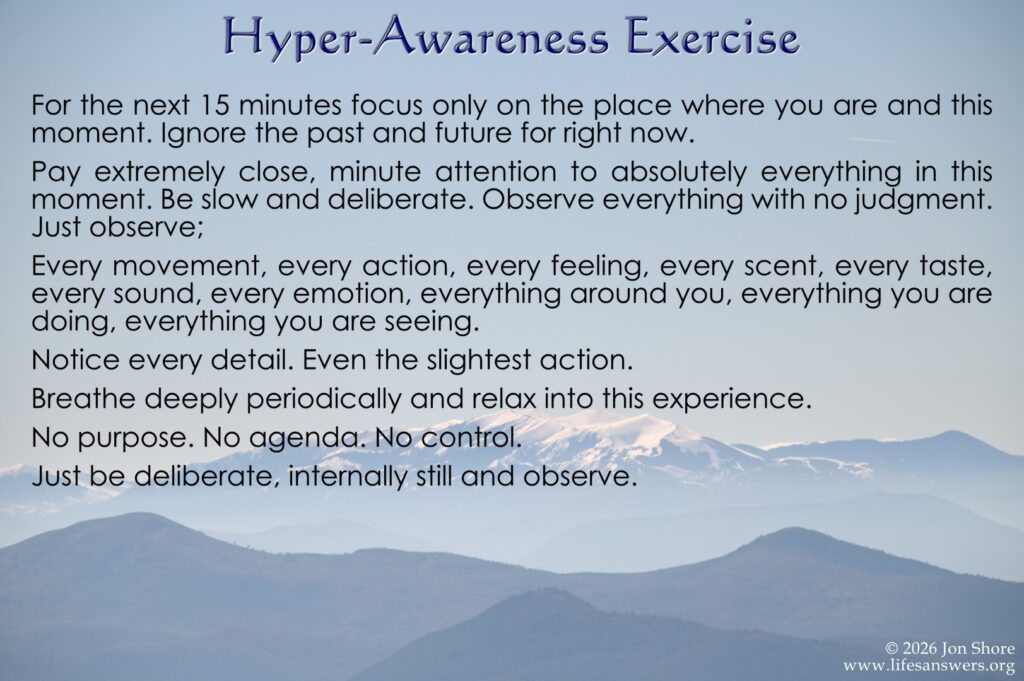
This exercise is also available in extended audio format here.
If you need help with any of this you can learn more about working with me and how to contact me directly here.